
You’ve probably run the numbers in your head a dozen times: build an ADU, rent it out, and let it help pay the mortgage. When it comes to ADU rental income Oakland CA homeowners can expect roughly $26,000–$43,000 a year in gross rental income, depending on the unit’s size, neighborhood, and whether it’s a detached backyard build or a garage conversion. Oakland’s rental market is tight enough that most legal ADUs lease within 2–4 weeks of listing, and the city’s permitting rules under the Planning and Building Department make new ADUs some of the most landlord-friendly units in the East Bay. This guide breaks down real rents by neighborhood, ADU type, ROI, and the rent control questions every Oakland homeowner asks before they build. Get a free estimate from a licensed Oakland contractor before you finalize your numbers.
How Much Rental Income Can an ADU Generate in Oakland?
An ADU in Oakland generally rents for $2,200 to $3,600 a month depending on size, bedroom count, and neighborhood, putting annual gross rental income for most homeowners in the $26,400–$43,200 range. A studio or one-bedroom unit sits at the lower end of that range, while a two-bedroom detached ADU near transit or in a higher-demand pocket of the city pushes toward the top.
Oakland’s ADU rental income depends heavily on three things: square footage, location, and whether the unit has private outdoor space or dedicated parking. A 400 sq ft studio ADU behind a home near Fruitvale might rent for $1,900–$2,300, while a 650 sq ft one-bedroom detached unit in a well-located neighborhood can command $2,600–$2,900. Two-bedroom units, especially those with in-unit laundry and parking, are the strongest performers citywide.
| ADU Size / Type | Typical Monthly Rent | Estimated Annual Income |
|---|---|---|
| Studio (350–450 sq ft) | $1,900–$2,300 | $22,800–$27,600 |
| 1-Bedroom (500–650 sq ft) | $2,200–$2,900 | $26,400–$34,800 |
| 2-Bedroom (700–900 sq ft) | $2,800–$3,600 | $33,600–$43,200 |
A homeowner in the Fruitvale district recently completed a 620 sq ft detached backyard ADU and leased it within three weeks at $2,650 a month, largely because the unit included its own entrance, in-unit laundry, and a small private patio. Those extras matter more in Oakland’s rental market than raw square footage.
What Do ADUs Rent for in Temescal, Rockridge, and the Laurel District?
ADU rents vary significantly by neighborhood in Oakland, with Rockridge and Temescal commanding the highest rates and the Laurel District offering strong value for both tenants and owners.
In Rockridge, a well-finished one-bedroom ADU near College Avenue can rent for $2,700–$3,100, reflecting the neighborhood’s walkability and proximity to BART. Temescal follows closely behind, with one-bedroom units typically renting for $2,500–$2,900 thanks to strong demand from young professionals drawn to the neighborhood’s restaurants and shorter commute into San Francisco.
The Laurel District tends to run a bit more affordable for tenants, which works in an owner’s favor too: lower finish costs, still-solid rents in the $2,200–$2,600 range for a one-bedroom, and typically faster lease-up times because the price point attracts a wider pool of renters. Two-bedroom units in all three neighborhoods add roughly $400–$700 a month over comparable one-bedroom rents.
Honestly, most homeowners assume the priciest neighborhood automatically wins on ROI, but that’s not always true once you factor in land cost and construction complexity. A smaller lot in the Laurel District with easy utility access can sometimes out-earn a cramped, expensive build in Rockridge once you run the full numbers.
Detached Backyard ADU vs. Garage Conversion: Which Earns More in Oakland’s Flatlands?
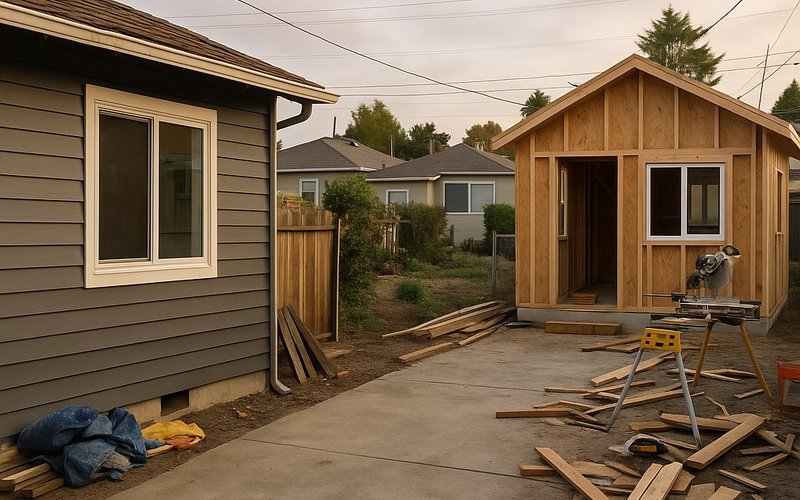
Detached backyard ADUs generally earn higher rents and better long-term ROI than garage conversions in Oakland’s flatlands, though garage conversions cost less upfront and cash-flow faster in the first few years.
A detached unit gives you full control over layout, ceiling height, and natural light, which tenants notice and pay for. Garage conversions in neighborhoods like Fruitvale and parts of East Oakland are often cheaper to build since they use an existing foundation and roofline, but they can rent for $150–$350 less per month than a comparable new-construction detached unit, largely because of lower ceilings, less natural light, and shared-wall noise concerns.
| Factor | Detached Backyard ADU | Garage Conversion |
|---|---|---|
| Typical Construction Cost | $220,000–$340,000 | $140,000–$220,000 |
| Average Monthly Rent (1BR) | $2,600–$2,900 | $2,200–$2,600 |
| Time to Positive Cash Flow | 7–10 years | 4–6 years |
| Resale Value Impact | Higher | Moderate |
So which one wins? For a homeowner planning to hold the property long-term, a backyard ADU in Oakland usually delivers the stronger return over a 10-15 year horizon, since detached units rent higher, hold value better, and give you flexibility to sell as a separate legal unit down the line under certain conditions. If your goal is the fastest possible payback with the lowest upfront cost, a garage conversion still makes sense, especially on a flatlands lot where the garage already has decent bones.
Does Oakland’s Measure JJ Rent Control Apply to a New ADU?
A newly constructed ADU in Oakland is exempt from Measure JJ rent control as long as it remains under its original certificate of occupancy and hasn’t been previously occupied as a rental unit before construction. This exemption applies to most new backyard and detached ADUs built after 1983, the state’s general cutoff for new-construction exemptions under the Costa-Hawkins Rental Housing Act, which Measure JJ operates within.
What this means practically: you can set your ADU’s initial rent at market rate and aren’t subject to Oakland’s annual rent increase cap, which is currently tied to 60% of the CPI increase for covered units. That said, once you sign a lease and a tenant moves in, standard just-cause eviction protections under Oakland’s Tenant Protection Ordinance still apply, even to exempt units.
Where homeowners get tripped up is with garage conversions of an existing structure that was previously rented, or additions to a multi-unit property built before 1983. In those cases, Measure JJ exposure gets more complicated, and it’s worth confirming your unit’s status with Oakland’s Rent Adjustment Program before you lease it out. New detached construction is the cleanest path to full rent-setting flexibility.
Can You Rent Out an ADU in California, and Does Oakland Require Owner-Occupancy?
Yes, California state law explicitly allows ADUs to be rented out, and Oakland does not require the primary homeowner to live on the property in order to rent out an ADU. This was clarified under state ADU law changes in recent years that removed owner-occupancy requirements statewide through at least 2026.
That means you can rent out both your main house and your ADU as separate units, or rent the ADU while living in the primary home, or even rent the ADU as a long-term investment property while renting the main house yourself. Oakland’s Planning and Building Department does require the ADU to be permitted correctly and doesn’t allow either unit to be used as a short-term rental under 30 days without separate hotel-tax registration, so plan for long-term tenants if maximizing income is your goal.
One thing to watch: while owner-occupancy isn’t required, some Oakland lenders still ask about it when underwriting a construction loan or HELOC for an ADU build, since it affects their risk assessment. If financing is part of your plan, it’s worth reading through options for how to finance an ADU in Oakland before you commit to a design.
How Much Does Section 8 Pay for an ADU in Oakland?
Section 8 payment standards for a one-bedroom unit in Oakland currently run around $2,400–$2,700 a month through the Oakland Housing Authority, with two-bedroom units typically approved in the $2,900–$3,300 range, depending on the household’s income and the unit’s condition.
These figures are set using HUD’s Fair Market Rent data adjusted for Oakland’s specific rental market, and they’re reassessed annually. For many homeowners, Section 8 tenants are attractive because a portion of the rent is paid directly by the housing authority, reducing the risk of missed payments, and the voucher amounts in Oakland are competitive with market rate, especially for one-bedroom units.
The tradeoff is a required unit inspection before move-in and annually afterward, along with slightly more paperwork than a standard lease. Most Oakland ADU owners who go this route find the inspection standards align closely with what you’d already need for a certificate of occupancy anyway, so it’s rarely a major hurdle for a newly built unit.
What’s the Real ROI on an ADU in Oakland After Construction Costs?
After accounting for construction costs, most Oakland homeowners see a net return of 4-7% annually on their ADU investment once the unit is rented, with full payback typically landing between 8 and 14 years depending on ADU type and neighborhood rents.
Here’s the real math: a 650 sq ft detached ADU built for $260,000 and rented at $2,750 a month generates $33,000 a year in gross income. Subtract property tax reassessment (roughly $2,600–$3,200 a year on the added value), insurance, maintenance reserves, and occasional vacancy, and you’re looking at net income closer to $26,000–$28,000 a year. Against a $260,000 build cost, that’s a payback window of roughly 10 years, plus the added resale value the ADU builds into your property permanently.
Garage conversions pencil out faster on paper since the build cost is lower, often $160,000-$200,000, but the lower rent ceiling means the annual ROI percentage lands in a similar range. If you’d like an accurate quote for your specific lot, comparing a detached build against a conversion side by side is the only way to know which actually performs better for your property. For a full cost breakdown, see this guide on backyard ADU costs in Oakland.
What Are the Disadvantages of Renting Out an ADU in Oakland?
The biggest disadvantages of renting out an ADU in Oakland are the upfront construction cost, added property tax liability, landlord responsibilities under Oakland’s Tenant Protection Ordinance, and the reality that vacancy or a difficult tenant can eat into your projected returns fast.
Construction is the obvious one. Even a modest ADU runs $160,000 or more, and financing that cost, whether through a HELOC, cash-out refinance, or construction loan, adds monthly carrying costs before you’ve collected a dollar in rent. Property taxes will also increase because Alameda County reassesses the added value under Proposition 13’s new-construction rules, typically adding $2,000–$3,500 a year to your bill.
Then there’s tenancy itself. Once someone moves in, Oakland’s just-cause eviction protections apply, meaning you can’t simply ask a tenant to leave without a legally valid reason, even for a newly built, rent-control-exempt unit. Screening tenants carefully upfront matters more in Oakland than in cities with looser eviction rules. And don’t underestimate ongoing maintenance: a detached ADU is still a full residential structure with its own roof, plumbing, and HVAC system that will need occasional repairs, typically 1-2% of build cost per year in maintenance reserves.
How Do Oakland’s Grants and Pre-Approved Plans Affect Your Rental Return?
Oakland’s pre-approved ADU plan program can shave 4-8 weeks off your permitting timeline, which directly improves your ROI by getting the unit rented sooner, though it doesn’t currently offer direct construction grants to most homeowners.
The City of Oakland’s Planning and Building Department maintains a list of pre-approved ADU floor plans that skip much of the standard plan review process, since the designs have already been vetted for code compliance. Choosing one of these plans can reduce your permitting timeline from the standard 4-6 months down to as little as 6-8 weeks in some cases, which matters more than homeowners often realize: every month you’re not collecting rent is a month of lost income against your ROI calculation.
While California has offered state-level ADU grant programs in past years (such as the CalHFA ADU Grant Program, which covered certain pre-development costs up to $40,000 for eligible homeowners), funding availability changes year to year and often runs out quickly. It’s worth checking current eligibility before you budget around a grant. A custom-designed unit still gives you more control over layout and finish quality, which often translates to higher achievable rent, so the pre-approved path is best suited to homeowners prioritizing speed over customization.
How to Find the Right Backyard ADU Builder in Oakland
The right ADU builder for Oakland is a licensed contractor with direct experience navigating the city’s Planning and Building Department, a track record of completed local projects, and a design process that accounts for your lot’s specific zoning and utility constraints.
Start by asking any builder you’re considering how many ADUs they’ve permitted specifically in Oakland, not just the greater Bay Area. Oakland’s setback rules, height limits, and utility connection requirements differ from neighboring jurisdictions, and a builder who hasn’t worked through Oakland’s process specifically will often underestimate your timeline. Ask to see completed projects in neighborhoods similar to yours, whether that’s a flatlands lot in Fruitvale or a hillier property near Rockridge.
- Confirm they hold an active California contractor’s license and carry proper insurance
- Ask for a realistic permitting timeline based on Oakland’s current review workload
- Request references from at least two completed Oakland ADU projects
- Clarify whether design, permitting, and construction are handled in-house or subcontracted
- Get a written cost breakdown that separates soft costs from hard construction costs
If your priority is maximizing rental income, a builder experienced specifically with backyard ADUs in Oakland will design your unit around what actually rents best locally: private entrances, in-unit laundry, and smart use of natural light. That’s the difference between a unit that leases in two weeks and one that sits vacant for two months while you cover the mortgage alone.
If you’re ready to see real numbers for your own property, reach out for a free consultation and get a project-specific estimate before you commit to a design or a builder. The sooner you get accurate numbers, the sooner you can decide whether a detached backyard build or a garage conversion makes more sense for your lot and your income goals.
Frequently Asked Questions
- What is the maximum rent increase allowed in Oakland under Measure JJ?
- In Oakland, Measure JJ caps annual rent increases at the CPI rate, capped at 10% total, for units built before 1983. Most ADUs are exempt from this cap since they’re new construction added after the cutoff date. That means you can set your own starting rent and adjust it between leases without going through the Rent Adjustment Program.
- Can I rent out my ADU in California without living on the property?
- Yes, California state law removed owner-occupancy requirements for ADUs permitted between 2020 and 2025, and Oakland follows this rule with no local owner-occupancy mandate as of 2026. You can rent out both your main house and your ADU to separate tenants. Some older Oakland permits issued before 2020 may carry different conditions, so check your original permit if you’re unsure.
- How much does Section 8 pay in Oakland, CA for a one-bedroom unit?
- The Oakland Housing Authority’s payment standard for a one-bedroom unit runs roughly $2,300 to $2,600 per month in 2026, depending on the unit’s location and condition. This often matches or beats market rent for a standard ADU in East Oakland or the Fruitvale area. Landlords still need to pass a Housing Quality Standards inspection before signing a Section 8 lease.
- What are the disadvantages of building an ADU for rental income?
- The biggest downside is upfront cost: a detached ADU in Oakland typically runs $180,000 to $340,000, and it can take 8 to 12 years of rental income just to break even. You also become a landlord, with all the maintenance calls, vacancy gaps, and tenant screening that comes with it. Property tax reassessment on the new square footage adds another ongoing cost most homeowners underestimate.
- How long does it take to start earning rental income after building an ADU in Oakland?
- In Oakland, plan on 10 to 14 months from permit application to a tenant moving in, covering design, the Planning and Building Department’s review, construction, and final inspection. Pre-approved ADU plans through Oakland’s standard plan program can shave 4 to 6 weeks off the permitting phase. Add another 2 to 4 weeks for marketing the unit and screening tenants before your first rent check arrives.
- Is a detached ADU or garage conversion a better investment in Oakland?
- A garage conversion earns back its investment faster, typically in 6 to 9 years, because it costs $95,000 to $160,000 versus $180,000 to $340,000 for new detached construction. A detached backyard ADU usually rents for $200 to $500 more per month because it feels more private and separate from the main house. If your Oakland flatlands lot has a usable garage and you want quicker cash flow, the conversion wins; if you want maximum long-term rent and resale value, detached is the stronger play.